REVIEW · STOCKHOLM
Beautiful Stockholm Small Group Walking Tour
Book on Viator →Operated by Stockholm DriveAndGuide · Bookable on Viator
Stockholm’s Royal highlights are close together. This small-group walk strings them into one tight route, so you get major landmarks without wasting time, and the guide’s visual, story-driven explanations make the buildings click fast.
I love that the tour keeps you moving through the city’s power centers and postcard corners in about 1 hour 45 minutes, then eases you into the medieval streets of Gamla stan. One thing to consider: it’s still a walking tour, so on a windy or cold day you’ll feel it, especially at open viewpoints like the bridge and palace-area lookouts.
In This Review
- Key highlights you’ll feel on the walk
- Why this Royal-and-Old-Town route works so well
- Royal Swedish Opera: the opening move for Stockholm’s power story
- Riksdagshuset: Sweden’s government story told through facades
- Riksbron and the skyline reveal: geography you’ll remember
- Lejonbacken: the photo spot that also teaches the city’s scale
- Slottsbacken and Palace Chapel: royal life in smaller moments
- Stortorget and Gamla stan: medieval streets that still guide your feet
- Price and time: what $106.42 buys you in real value
- Practical tips so the walk feels easy, not stressful
- Who should book this small-group walk
- Should you book it?
- FAQ
- How long is the Beautiful Stockholm Small Group Walking Tour?
- What is the price per person?
- Is the tour offered in English?
- How big is the group?
- Where does the tour start and end?
- Are there admission fees for the stops?
- Is the tour near public transportation?
- What fitness level do I need?
- Do I get a mobile ticket?
- Can I cancel for free?
Key highlights you’ll feel on the walk
- Small group (max 10) means you can ask questions and still keep a good pace
- Clear visual explanations help you understand why Swedish institutions look the way they do
- Royal Palace area photo stops at Lejonbacken and Slottsbacken set you up for great pictures
- Riksbron viewpoints give you quick city geography: islands, government buildings, and City Hall
- Gamla stan street pattern comes alive on Merchants Street and the walk down to Skeppsbron
- English mobile ticket and a route designed around public-transport access make it low-stress
Why this Royal-and-Old-Town route works so well
This tour is built around one simple idea: Stockholm’s power and its old streets are right next to each other. You start near the Royal Swedish Opera and move toward the government center, then shift into classic palace viewpoints and finish in the heart of Old Town.
That flow matters. If you tried to do this on your own, you’d likely bounce between areas, lose time crossing streets, and miss the connections between what you’re seeing. Here, each stop sets up the next one, so the day feels like a guided walk with a map in your head—not just a sequence of photos.
And at about 1 hour 45 minutes, it’s long enough to learn something real but short enough to still enjoy the rest of the day.
You can also read our reviews of more walking tours in Stockholm

Royal Swedish Opera: the opening move for Stockholm’s power story
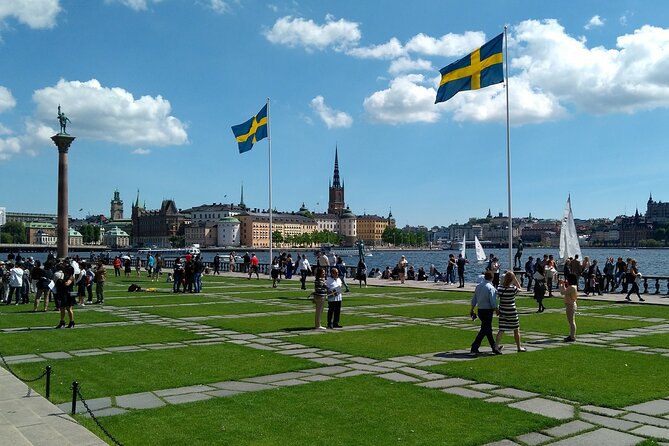
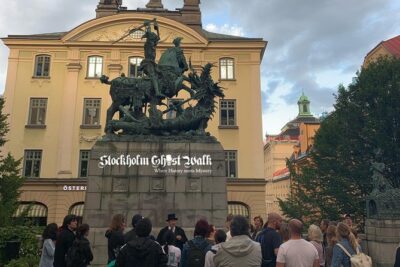
The walk begins at Gustav Adolfs torg and kicks off with a quick orientation to Sweden and Stockholm—then it points you straight at the Royal thread running through the architecture. You’ll look toward the Royal Palace area and get a sense of how buildings here got tied to the crown.
The Royal Swedish Opera is a smart first stop because it gives you two kinds of context right away:
- A literal sense of place, with Royal connections shaping the feel of the square
- A cultural connection through the opera world, including the opera The Masked Ball by Giuseppe Verdi about Swedish king Gustav III
You’ll also hear how nearby buildings have shifted roles over time. For example, a classic-style building across the square now houses the Ministry of Foreign Affairs, but it was once linked to the royal family as the Heir Presumptive palace. That’s the theme: Sweden didn’t just build impressive structures—it repurposed them as power evolved.
At this stop, you’re not paying for entry (the experience lists the stop as free), so it’s a great way to start without friction.
Riksdagshuset: Sweden’s government story told through facades
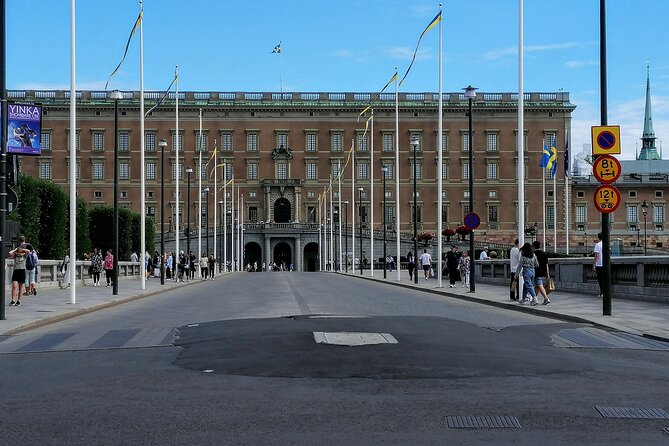
Next comes the Parliament Building (Riksdagshuset), and it’s one of those places where the outside already tells you the era. The building is described in Neo-Renaissance style, with a facade section in Neo-Baroque styling, and that contrast is a clue: Sweden’s national identity has layers, not one straight line.
The guide’s explanation helps you place it in time:
- Construction ran from 1897 to 1905
- Before this, Sweden had the Riksdag of the Estates (Ståndsriksdagen) where nobles, clergy, burghers, and peasants met separately
- That system lasted until 1866, then a parliament with two chambers came in—but with unequal voting rights at first
- General suffrage came in 1921
- In 1975, the constitution changed and the two chambers merged into one
- The king’s role was confirmed as representative rather than having real power
You don’t have to be a political-science person to get value here. When you stand in front of the building and hear the voting timeline, you start reading the architecture differently—less like a “pretty building” and more like a physical record of how citizens gradually gained influence.
This is another free-to-view stop, and it’s also short enough to keep the whole tour moving.
Riksbron and the skyline reveal: geography you’ll remember
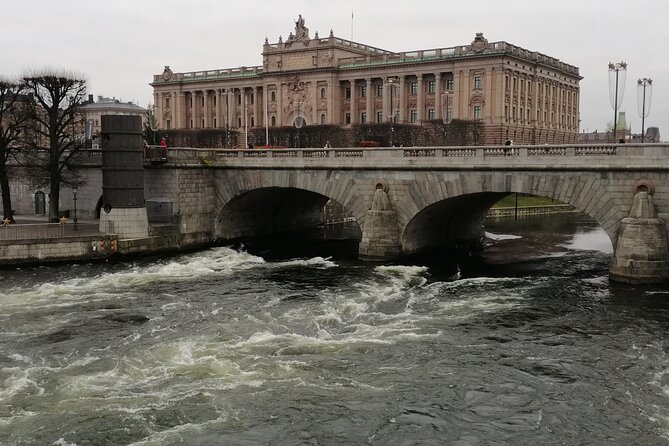
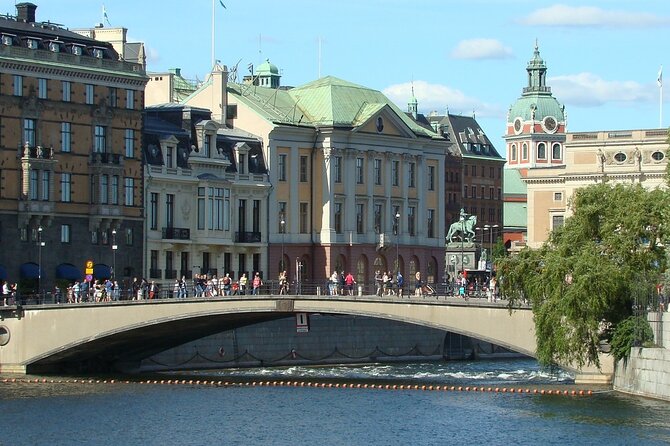
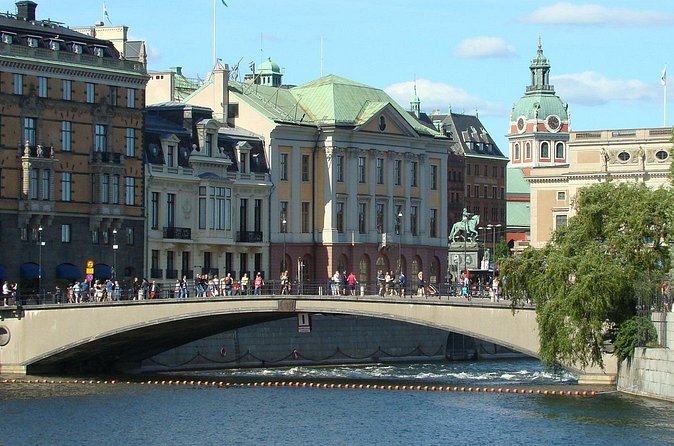
From the Riksbron bridge, the tour becomes less about individual buildings and more about Stockholm as a city of water and institutions. You’ll get a view toward Knights Island, the Prime Minister’s residence, the Government building, and the House of Nobility.
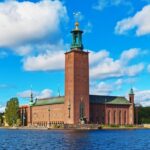
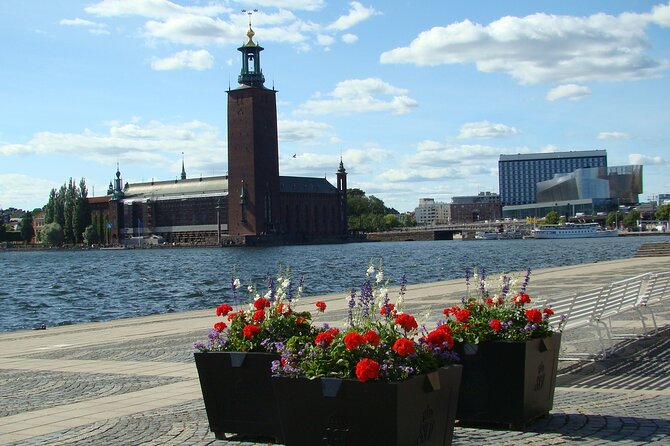
If you care about street-level orientation, this is a high-value moment. A bridge view acts like a visual “north-south” page in the city’s atlas. You also see the City Hall, the one that hosts the Nobel Prize banquet each year.
Then the conversation shifts toward what all these sites mean together: Stockholm’s institutions aren’t hidden away in one district. They stack in sightlines, so the city feels like it’s teaching you where power sits.
And yes, this is also where wind can pick up. If you’re visiting in colder months, bring a layer that blocks the breeze.
Lejonbacken: the photo spot that also teaches the city’s scale
Lejonbacken is on the north side of the Royal Palace, and it’s one of the most popular photo spots in Stockholm for a reason. The views put the palace area and the surrounding districts into the same frame, so you can see how old royal power meets more modern city building.
During this stop, you’ll spot:
- The Royal Garden with a statue of Karl XII, the last of Sweden’s warrior kings
- The Financial District area built around the turn of the 20th century, when architectural styles flourished
- The Grand Hotel, known for prestige and where Nobel laureates stay during ceremonies
Even if you don’t plan to go inside the hotel, it’s a useful marker. It tells you that Stockholm doesn’t treat “famous” and “functional” as separate worlds. It blends institutions, culture, and economics in close proximity.
If you time your photo right, you can capture the palace approach with enough city context to make the shot look like Stockholm—not just a generic palace view.



Slottsbacken and Palace Chapel: royal life in smaller moments
The tour then moves toward Slottsbacken, where you pass the inner courtyard of the Royal Palace and take a short visit to the Palace Chapel. This is the kind of stop that changes the feel of the day. After all the civic and governmental talk, the chapel adds a more personal layer—ceremony, family life, and tradition.
Outside, you’ll see a statue of Carl XIV Johan. The guide explains his career path—from the Napoleonic wars into the Swedish royal family—and he also connects this to what Sweden gained (and what it had to recover) after conflicts with Russia.
You’ll hear that diplomacy, infrastructure, and education were key parts of his approach. There’s also a wider arc here: Sweden’s 200 years of peace were celebrated in 2014, and the industrial revolution and Swedish inventions helped build a base for a welfare state.
This is a lot to pack into a short walking moment, but it lands because you’re standing in the right context. It doesn’t feel like a lecture. It feels like the city is giving you the footnotes.
Stortorget and Gamla stan: medieval streets that still guide your feet
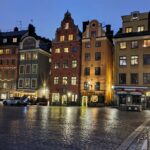
Then you shift into Old Town with Stortorget, the central square and one of the most photographed spots in Stockholm. The square is surrounded by buildings in 17th-century Scandinavian Renaissance and 18th-century Classicism styles, so you can see how the old core kept evolving without losing its identity.
This square also carries a very specific story: the Bloodbath of Stockholm in November 1530, when Danish king Christian II had around 100 noblemen and priests beheaded. In Sweden, he’s known as Christian the tyrant. Whether you like grim history or not, it’s important context for why old-town squares here feel charged.
From Stortorget, the Nobel thread returns in a different way: the Nobel Prize Museum is situated there, and winners in many fields of science and art are designated by Swedish royal academies and committees. Even if you don’t enter the museum, this location helps you link the city’s modern global brand to its physical streets.
From there, you walk into Old Town’s medieval lanes, including:
- Köpmangatan (Merchants Street), documented in writing since 1350
- Narrow alleyways that make the medieval atmosphere feel close instead of distant
- Österlånggatan
- Down to Skeppsbron, where ships have loaded cargo since the 17th century
This end section is where you’ll appreciate the tour’s pace. You get the “big institution” story first, then the “how people lived and moved goods” story second. That order makes Gamla stan feel like more than a cute maze.
Price and time: what $106.42 buys you in real value
At about $106.42 per person for roughly 1 hour 45 minutes, you’re paying for more than walking. You’re paying for:
- Tight route design that connects Royal, civic, and Old Town areas efficiently
- A guide who explains why buildings look the way they do, not just what they are
- A small group size (max 10), which improves the quality of the experience if you like asking questions or hearing additional context
If you’re the type who enjoys details—architecture terms, time periods, and the why behind major institutions—this price starts to make sense fast. You’re not just collecting photos. You’re translating what you see.
If you prefer silent wandering with no narration at all, then a guided format might feel expensive. But if you want your first day in Stockholm to make sense in one go, it’s strong value for the time.
Also, it’s booked about 11 days in advance on average, which usually signals steady demand. That matters if you want a particular day or time.
Practical tips so the walk feels easy, not stressful
A few details will help you get the most from the route:
- Bring layers. The route includes open viewpoints like bridges and palace-area lookouts, so wind happens.
- Expect moderate walking. The experience is aimed at people with moderate physical fitness, so wear comfortable shoes you trust.
- Use the mobile ticket. It’s provided as a mobile ticket, so you don’t need to scramble for paper.
- Go in with a loose plan for afterward. The tour ends at the southern end of Kungsträdgården, a park area in central Stockholm. If you want to keep going, you can take the tram to Djurgården, home to museums like Vasa Museum, Viking Museum, ABBA museum, and Skansen.
Finally, the meeting and ending points are specific:
- Start at Gustav Adolfs torg, 111 52 Stockholm
- End near the Karl XII statue (Karl XII:s torg 9, 111 47 Stockholm) and then at the park south of Kungsträdgården
You’ll find this helpful for mapping your next stop.
Who should book this small-group walk
This one fits best if you:
- Want an efficient overview of Stockholm’s Royal and civic sites
- Like guided architecture and institutional storytelling, with explanations that help you connect the dots
- Prefer a small group format (up to 10 people) over large crowds
- Are comfortable walking for about 1 hour 45 minutes at a moderate pace
It’s also a great choice for first-time Stockholm visitors who want their bearings quickly.
Should you book it?
Yes, if you want a guided, high-footprint route that turns iconic landmarks into a coherent story. The best reason to book is simple: you’ll leave with a stronger sense of Stockholm’s institutions and Old Town streets than you would from photos alone.
Skip it only if you strongly dislike guided commentary or you want to spend your time purely at one neighborhood. Otherwise, this walk is a smart way to get value early in your trip—and still have energy for the museums afterward.
FAQ
How long is the Beautiful Stockholm Small Group Walking Tour?
It’s approximately 1 hour 45 minutes.
What is the price per person?
The price is $106.42 per person.
Is the tour offered in English?
Yes, it’s offered in English.
How big is the group?
The maximum group size is 10 travelers.
Where does the tour start and end?
It starts at Gustav Adolfs torg, 111 52 Stockholm, Sweden. It ends near the Karl XII statue area (Karl XII:s torg 9, 111 47 Stockholm) at the southern end of Kungsträdgården.
Are there admission fees for the stops?
The stops listed are marked as admission ticket free.
Is the tour near public transportation?
Yes, it’s near public transportation.
What fitness level do I need?
The tour is for travelers with a moderate physical fitness level.
Do I get a mobile ticket?
Yes, the tour provides a mobile ticket.
Can I cancel for free?
Yes. Free cancellation is available up to 24 hours in advance for a full refund.