REVIEW · STOCKHOLM
Stockholm Must See – Old Town, boat + Vasa Museum 3h small group
Book on Viator →Operated by Sweden History Tours · Bookable on Viator
Old Town can feel like a movie set. This 3-hour Stockholm combo pairs a guided walk through Gamla Stan with a ferry hop to Vasa Museum, so you get context fast. The guide’s stories connect the city’s drama to real street corners and monuments, not just a map and a few facts.
I especially love the way this route hits the big moral shocks of Stockholm’s past in walking distance. You’ll move from Slottsbacken’s Gustav III backdrop to Stortorget’s Bloodbath of Stockholm, and you’ll do it with a guide handling the why behind the what. I also like the practical value: a one-way ferry is part of the plan, and Vasa Museum includes skip-the-line access, which matters when lines eat your day.
One drawback to plan for: Vasa tickets aren’t included, and the guided museum time is limited. If you want to linger at every exhibit, you’ll likely need a bit of extra time on your own after the tour ends.
In This Review
- Key moments that make this tour work
- The smart format: walking Gamla Stan, then ferrying to Vasa
- Slottsbacken Obelisk and the Royal Opera link: a murder story with street-level payoff
- Stortorget to Nobel Prize Museum: squares where Stockholm’s blood ran
- Runestones and Prästgatan: the alleyways that explain Stockholm’s darker side
- Riddarholmen and Järntorget: monks, fires, and trade networks
- Marten Trotzigs Grand and Skeppsbrokajen: tiny streets, big stories, then the harbor
- Djurgården walk: hunting grounds, WWII shelters, and Viking-age clues
- Vasa Museum: skip the line, then make your 40 minutes count
- Price and value: $135.69 for a mini-history course with real extras
- Who this tour suits best in Stockholm
- Practical tips before you go (so it feels smooth)
- Should you book this Stockholm Old Town + Vasa tour?
- FAQ
- How long is the Stockholm Old Town, boat, and Vasa Museum tour?
- What’s included in the price?
- Are Vasa Museum tickets included?
- How many people are in the group?
- Where does the tour start and end?
- Does the tour run in bad weather and in what language?
Key moments that make this tour work
- A tight Old Town loop that connects monuments, squares, and alleyways to real events
- Ferry to Djurgården with harbor-and-trade viewpoints before you hit the museum island
- Skip-the-line at Vasa Museum so your time goes to the ship, not the queue
- High-drama history beats (Gustav III, the Bloodbath, executioners, medieval battles) without feeling like homework
- A small group cap of 15 that keeps the pace moving and questions welcome
- All-weather operation, so you keep your schedule even when Stockholm does what Stockholm does
The smart format: walking Gamla Stan, then ferrying to Vasa
This tour is built for a common Stockholm problem: you want the classics, but you also want the stories. The format solves that by mixing short walks with brief stops, then ending at Vasa Museum with guided interpretation. You get a full day’s worth of meaning packed into about three hours, without trying to cram every museum in the city.
The key move is the ferry. Stockholm’s water is part of how the city worked—trade, transport, and defense—so seeing the waterfront before you leave the Old Town makes the later museum stop land better. If the weather is gray or rainy, the ferry ride still gives you a reset, and the tour keeps rolling.
Group size matters here. With a maximum of 15 people, you shouldn’t feel swallowed by a huge bus crowd. In that tighter format, the guide can actually connect events to what you’re standing next to.
You can also read our reviews of more boat tours in Stockholm



Slottsbacken Obelisk and the Royal Opera link: a murder story with street-level payoff
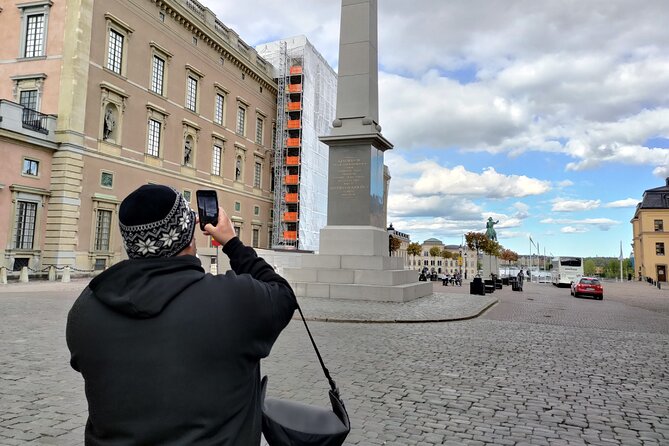
Your meeting point is Gustav III’s Obelisk at Slottsbacken. Even if you’ve only seen the name Gustav III in passing, this stop is designed to wake it up. The guide ties the obelisk to the history of the killing of King Gustav III at the Royal Opera, and suddenly a monument isn’t just stone—it’s a bookmark for a national turning point.
Why I like this opener: it frames the rest of the day. Old Town in Stockholm isn’t laid out as a neat timeline. It’s a layered city where power, religion, violence, and politics overlap. Starting with a dramatic anchor helps you read the buildings as clues.
You’ll also catch a glimpse of the Finnish church of Stockholm nearby. The stop is brief, but it signals something important: Stockholm has always been a mix of languages and cultures, not just a single-storied postcard.
Then you continue into the Royal Palace area. Expect short, high-level historical context about monarchy—enough to understand why this power sits at the center of the city’s identity, without drowning you in dates.
Stortorget to Nobel Prize Museum: squares where Stockholm’s blood ran
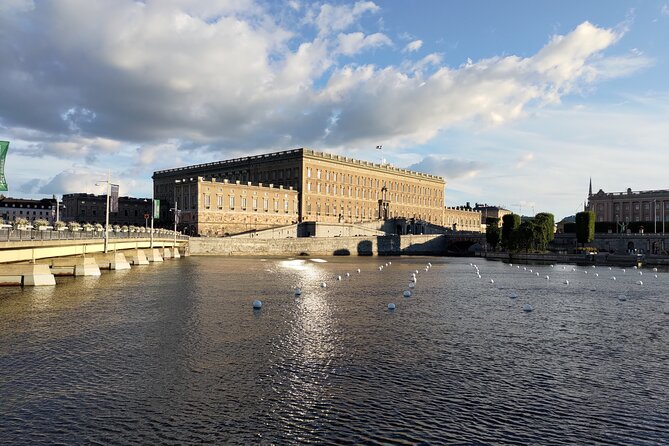
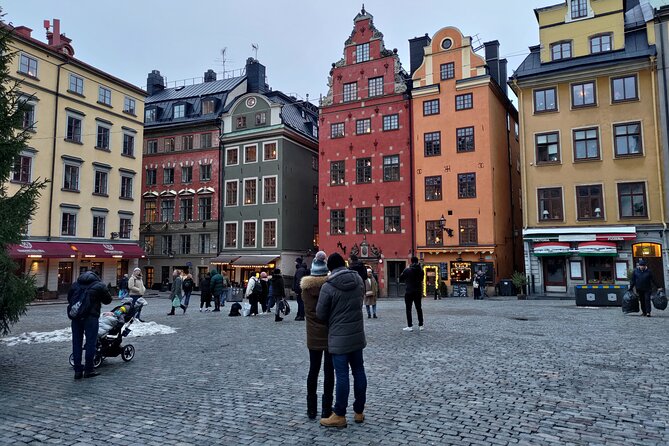
Stortorget is the main square of Old Town, and it’s one of the best places to learn Stockholm because it’s still a functioning public space. When you stand there with a guide, you can feel why the city repeats itself: markets and public life sit right beside harsh political history.
This stop centers on the Bloodbath of Stockholm story, which is often taught in broad terms. Here, it’s tied to the square and the 17th-century façades, so you’re not just hearing about violence—you’re looking at the stage where it unfolded. If you’re the type who learns by seeing, this is where the tour clicks.
From Stortorget, you pass the Nobel Prize Museum area. Even if you don’t go inside, you’ll hear about Alfred Nobel and how the square’s long life connects to that modern legacy. It’s a clever contrast: a place remembered for brutality now wrapped in the language of prizes and ideas.
Runestones and Prästgatan: the alleyways that explain Stockholm’s darker side
Old Town has alleys that look like shortcuts, but they’re really history corridors. A quick visit to a runestone gives you a sense of how far back the city’s story goes—long before royal palaces and big squares. These stones are rare physical links to earlier eras, and seeing one in context helps you understand why locals treat them like more than curios.
Then you hit Prästgatan, known as the Alley of Hell. The tour uses this area to tell you about executioners of Stockholm. I appreciate the approach: it isn’t just gore for shock value. It explains the systems—who carried out punishment, how power was enforced, and how public fear worked in a very physical way.
A brief stop near Storkyrkan (Stockholm’s main church) adds another layer. The guide explains the church’s story and ties it to life in ancient Stockholm, with mention of recent archaeological excavations. That matters because it shows the city is still being read and corrected by new finds. History here doesn’t feel dead; it feels like ongoing research with consequences.
Riddarholmen and Järntorget: monks, fires, and trade networks
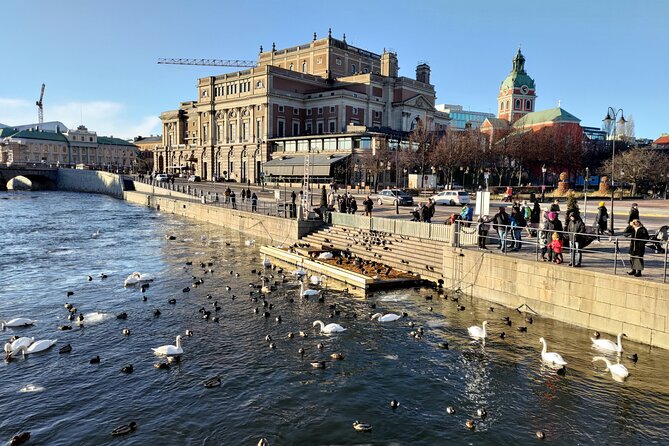
Riddarholmen is often described as the isle of the Nobels, but the tour doesn’t leave it at branding. You’ll hear stories about monks, death, and fires and flames—so you understand how the religious and civic worlds overlapped. This is a strong stop if you like atmosphere, because the narrative pulls together how people lived, believed, and suffered.
The House of Knights in the area also comes into the story. That’s the kind of detail that helps you “zoom out” from street-level drama to the institutions that shaped it.
Next comes Järntorget, the Iron square. Here the guide shifts from crime and punishment to economics. You’ll learn about trade networks and the German part of Old Town. This is a reminder that Stockholm wasn’t only a royal stage—it was a trading hub, and foreigners and merchants mattered.
If you’ve ever wondered why Old Town streets feel like they were built by different eras at once, this is the explanation. The city grew by movement: goods, people, money, and ideas. Squares and streets reflect that.
You can also read our reviews of more museum experiences in Stockholm






Marten Trotzigs Grand and Skeppsbrokajen: tiny streets, big stories, then the harbor
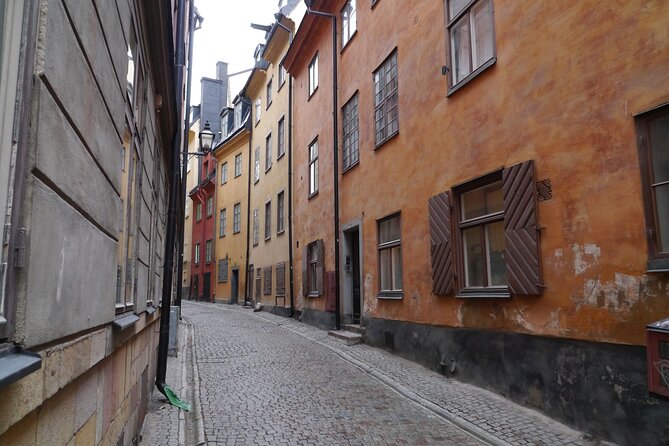
Marten Trotzigs grand is famous for being extremely narrow—so narrow you have to physically slow down to take it in. The tour uses that constraint to tell the tragic fate behind the alley’s name. It’s a reminder that “small” spaces often hold big stories, especially in medieval cities where space was never evenly distributed.
Then you move toward Skeppsbrokajen Promenade. While waiting for the ferry to Djurgården, you walk the old harbor area and learn about Stockholm’s trade and waterways. This is practical history: how ships shaped where people lived, worked, and built wealth.
I like this timing. By the time you step onto the ferry, you’ve already heard the logic of water movement. The ride doesn’t feel like a transfer. It feels like part of the lesson plan.
Djurgården walk: hunting grounds, WWII shelters, and Viking-age clues
Once you arrive on Djurgården, you take a shorter city walk on the island. The tour frames Djurgården as former royal hunting grounds and a military navy island that later became a museum and park area. That shift—from control and survival to public access—gives you a sense of how Stockholm reuses its own spaces.
One of the most interesting parts here is the mention of Vrak and Viking museums. The tour explains they’re hosted in WWII shelters built to withstand airplane bombs. Even if you don’t go inside, hearing that context makes the location feel layered with survival history, not just leisure.
You’ll also see modern runestones at the entrance and hear about the Viking age. It’s not pretending the runes are medieval originals; it’s using the markers to point you toward the broader Viking-era story the island still signals.
Then the route includes Galarvarvet, tied to the history and remains of an old naval base moved from there in the 1970s. That detail is helpful because it explains how Stockholm’s past sometimes gets physically rearranged—yet the story remains traceable.
Nordiska Museet is also passed by. You’ll hear about its collection and what it focuses on, including Nordic history since the 1800s and objects connected to Sweden and the Nordic between 1500 and today. Since your time is tight, the stop is brief—but it gives you a direction for future visits if you want more.
Vasa Museum: skip the line, then make your 40 minutes count
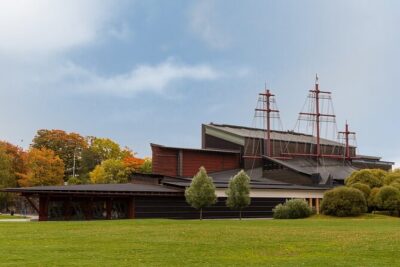
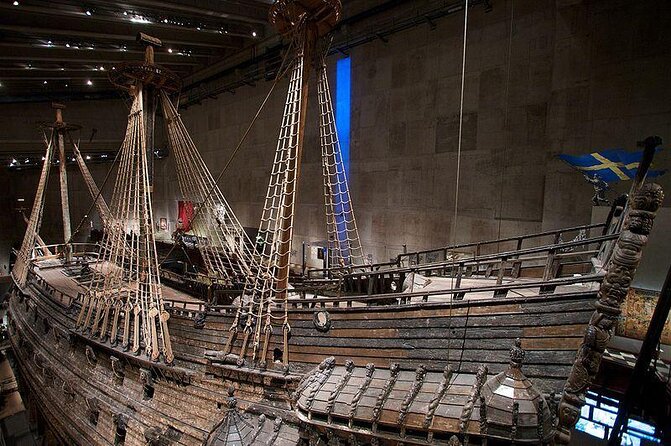
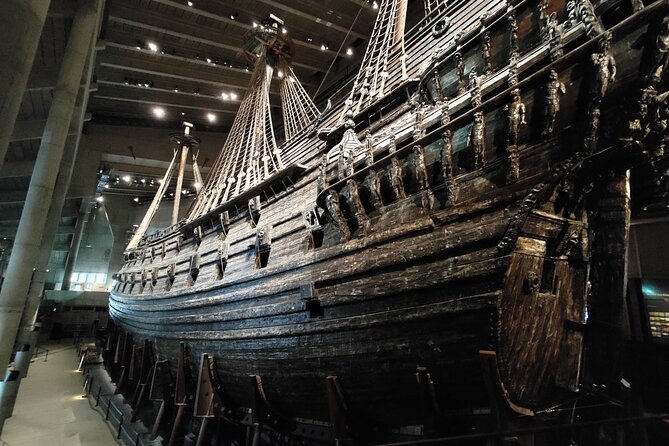
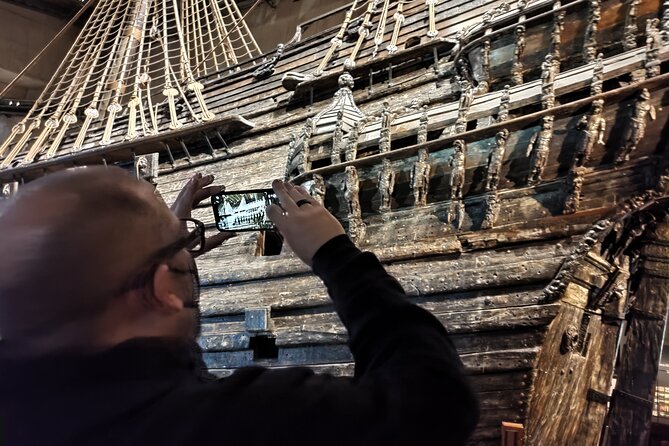
Vasa Museum is the climax for a reason. The ship itself is the hook: a 17th-century warship that sank on its maiden voyage. The tour highlights that it sailed only about 1,200 meters before going down, and that today the experience is possible because the wreck is displayed with 98% complete original wood from the ship’s time. The museum viewing is built around the ship’s almost 40-meter length.
Because Vasa tickets aren’t included, you’ll want to add that cost on top of the tour price. Still, the tour includes skip-the-line access, and that’s where the value shows. At Vasa, lines can be a full-length story of their own, and skipping them protects your scheduled time.
Your guided time is about 40 minutes, so here’s how to use it well. I’d treat the guided portion as your map and your story anchor:
- Listen for what makes the ship a “case study,” not just a relic
- Use the guide’s explanation to decide what you want to see more carefully after the tour ends
- If you’re fascinated by details, ask questions early—your guide’s job is to connect the ship to what you’re looking at right now
One key consideration: the tour also runs in the afternoon (there’s a later start option described with the meeting point outside Vasa). In practice, that means museum timing can feel tighter. If you care most about Vasa itself, try to choose the departure that gives you the best chance of feeling un-rushed inside the museum.
Price and value: $135.69 for a mini-history course with real extras
At $135.69 per person, this tour sits in the “worth it if it saves your time” category. You’re paying for three things that are hard to DIY:
- A guided Old Town route that connects stories to exact places
- A ferry element that supports the geography lesson
- Skip-the-line access for Vasa Museum
The math also depends on your priorities. If you’re the type who plans museums like a checklist, you might feel the tour is mostly a lead-in. If you like walking, asking questions, and turning monuments into context, the guide work is where the money shows up.
Also, it’s capped at 15 people, which keeps it closer to a small-group walk than a mass-tour shuffle. That kind of size is part of the value proposition, because you’re more likely to get real explanations instead of just hearing the same script over the crowd.
One practical note: you’ll still need to buy Vasa Museum admission separately. The tour includes skip-the-line access, not the ticket itself.
Who this tour suits best in Stockholm
I’d recommend this experience if:
- You’re on your first trip to Stockholm and want the “must see” storytelling in one package
- Your schedule is tight and you don’t want to piece together Old Town, the harbor, and Djurgården on your own
- You enjoy history told through places—square to alley to church—rather than through a single museum
It also makes sense if the weather is unpredictable. The tour is designed to operate in all weather conditions, so you don’t lose the day if it turns rainy.
If you’re traveling with limited mobility or you prefer long seated breaks, you might want to consider whether the walking pace and multiple stops match your comfort. The route is described as suitable for travelers with moderate physical fitness, so it’s not an all-sit itinerary.
Practical tips before you go (so it feels smooth)
- Wear walking shoes. Old Town streets aren’t uniform, and you’ll be on your feet for most of the session.
- Bring a layer. Stockholm weather can shift fast, and the tour runs in all conditions.
- If you care about Vasa most, double-check the departure timing. Your museum time can feel tighter on later starts.
- Save your biggest questions for the start of the Vasa portion. You’ll get more value from the guide’s explanations when you can immediately connect them to what you’re seeing.
Should you book this Stockholm Old Town + Vasa tour?
Yes, if you want the fast version of Stockholm that still feels meaningful. The route is efficient, the storytelling is built around major places (Stortorget, Prästgatan, Riddarholmen, Djurgården), and the skip-the-line Vasa access protects one of your most time-sensitive stops.
I’d skip it only if your goal is deep museum time without a guided structure. In that case, you might prefer a longer Vasa-focused visit plus a separate Old Town self-walk.
If you’re juggling limited time and want the city to make sense quickly, this is a strong choice.
FAQ
How long is the Stockholm Old Town, boat, and Vasa Museum tour?
The tour lasts about 3 hours.
What’s included in the price?
The tour includes a guided Old Town city walk, a one-way ferry ticket, local authorized Stockholm city tour guide services, central meeting point convenience, and skip-the-line access to the Vasa Museum. Mobile tickets are used.
Are Vasa Museum tickets included?
No. Vasa Museum admission tickets are not included.
How many people are in the group?
The tour has a maximum of 15 travelers.
Where does the tour start and end?
It starts at Gustav III’s Obelisk, Slottsbacken 1, 111 30 Stockholm, and ends at Vasa Museum, Galärvarvsvägen 14, 115 21 Stockholm.
Does the tour run in bad weather and in what language?
It operates in all weather conditions, and it is offered in English.