REVIEW · STOCKHOLM
Stockholm Pass: Save up to 50% – Includes Vasa Museum
Book on Viator →Operated by Go City | Stockholm · Bookable on Viator
This pass turns Stockholm into a choose-your-own route. It’s built around a digital pass with QR codes on your phone, so you can skip voucher redemptions and jump into sights fast. I like the wide menu, including the Vasa Museum, royal stops, and archipelago boat time.
I love how you get a built-in planning tool: the Go City app plus a downloadable digital guide for sightseeing info in advance. I also like that the pass covers both big-ticket classics (like palaces and major museums) and smaller diversions that help you shape days your way, not someone else’s schedule.
One thing to watch: the pass only works for consecutive calendar days once activated, and some sites can be picky about QR scanning or seasonal boat schedules. If you’re traveling at the edge of winter or right when a ride stops running, you’ll want backup ideas ready in the app.
In This Review
- Key Things to Know Before You Go
- Stockholm Pass Value: How Much You Really Get
- QR Codes and App Sync: The Biggest Make-or-Break
- Entering Vasa Museum: The Shipwreck That Anchors Stockholm
- Royal Palace + Royal Armoury: Baroque Rooms and Parade Gear
- Old Town Churches and the Nobel Prize Museum: Short Stops, Strong Atmosphere
- Vikings, Photography, Science, and Spirits: Museums That Change Your Day
- Skansen and Gröna Lund: Djurgården Day Planning
- Globen SkyView and Camera Time: A Great Vertical Perspective
- Nobel Street-Level Genius vs. Big Museum Rooms
- Canal Tours and Archipelago Boats: Build a Water Day (With Backup)
- Drottningholm Palace and Court Theatre: UNESCO Royal Time Travel
- When the Hop-On Hop-Off Buses Help (and When They Don’t)
- A Smart Way to Use This Pass in 2 Days
- Should You Book the Stockholm Pass?
- FAQ
- What’s the main advantage of this Stockholm Pass?
- Does the pass include Vasa Museum admission?
- How long is the pass valid once activated?
- Are all attractions available year-round?
- Do all included attractions require reservations?
- Is ICEBAR Stockholm included for everyone?
Key Things to Know Before You Go

- QR entry on your phone means less paperwork and fewer ticket counters to track down
- Downloadable digital guide helps you pre-plan routes and timing instead of guessing in the city
- Archipelago options are seasonal, so check dates for boats like Birka, Vaxholm, and Fjäderholmarna
- Major hits are included, including Vasa Museum and palace-area museums
- Some activities need reservations, so you may have to do a quick planning step in the app
Stockholm Pass Value: How Much You Really Get
At $101.70 per person, this pass is a “use it a lot” product. The value kicks in when you do multiple paid attractions per day, especially the headline museums and any included boat or sky-view experiences. The pass is designed for 1 to 5 days (you pick how long you want), and it’s valid for consecutive calendar days after your first attraction.
Here’s the practical way to think about it: if your plan is mostly one or two stops, you’ll feel the cost. If you plan like a museum-hopper—think 3+ solid sights in a day—the pass tends to start paying you back. That pattern shows up again and again: people get the best outcome when they stack admissions efficiently rather than spreading them thin.
Also note the rules that affect value. Each attraction can only be visited once, and passes activate on your first visit, then remain valid for the calendar days you purchased—not a floating 24-hour window. That detail matters if you’re trying to stretch a two-day pass across long travel days.
Finally, keep this in mind for your pace: the experience has a maximum group size of 9 travelers. That usually means less chaos than big group tours, but it doesn’t change the fact that you’ll still be doing a self-guided plan with your phone.
You can also read our reviews of more museum experiences in Stockholm



QR Codes and App Sync: The Biggest Make-or-Break
The headline promise is simple: show your QR code on your cellphone and enter select attractions. There’s no voucher redemption step, and you can sync your pass in the Go City app right after order confirmation (you’re instructed to hit Get ticket and sync).
That said, don’t treat QR as a magic wand. A lot of the negative friction comes from one of these problems:
- Your phone shows the wrong code (or you’re using something other than the Go City QR flow)
- The QR isn’t available in time or doesn’t scan cleanly at a specific museum
- Some places require a different process when reservations or seasonal schedules are involved
My advice is boring but effective: before you leave your hotel, open the Go City app and confirm your QR is visible for entry. If you’re using an iPhone wallet or another add-on, don’t assume it’s always the exact entry method at every site. Bring a screenshot of your QR screen as a backup.
Also, a chunk of the included list has “seasonal attraction” notes. That means boat and outdoor experiences may not run year-round. The pass can still be worth it, but your planning needs a Plan B.
Entering Vasa Museum: The Shipwreck That Anchors Stockholm
If you only do one “big” thing, make it Vasa Museum. It’s one of Sweden’s major cultural treasures: the warship Vasa sank in 1628 on its maiden voyage from Stockholm. Inside, you’ll see restored parts of the wreck that were salvaged from beneath the water, plus exhibitions that explain what the ship was, why it sank, and what its story tells us about the era.
The visit time listed is about 1 hour, and that’s a realistic target if you want to read key panels and actually look at the wreck details. The museum is also the kind of stop where you’ll understand your next choices better—because it sets context for why Stockholm’s history is so tied to water, trade, and power.
A practical tip: give yourself extra breathing room on your first day. The city can be navigationally tricky until you get your bearings, and Vasa is the kind of place where rushing makes you miss the best parts.
Royal Palace + Royal Armoury: Baroque Rooms and Parade Gear

Two royal-themed stops pair nicely if you like history you can walk through.
The Royal Palace visit is about 1 hour and focuses on what it’s like to live in the Swedish royal residence—plus the design scale. The palace is described as baroque, with around 600 rooms across 11 floors. Even if you don’t plan to see every corner, the sheer layout is part of the experience.
Next door in theme, the Royal Armoury (Livrustkammaren) is about 1.5 hours. This is where the royal story shifts from architecture to objects: items from royal wardrobes, arsenals, parade armor, weapons, and also recognizable coaches from historical ceremonies. If you like costume-and-craft museum energy, this is a great pairing with the palace.
Timing-wise, these two are easier when you plan them on the same day. You’ll mentally connect the rooms and the ceremonial gear instead of treating each one as a separate bullet point.
Old Town Churches and the Nobel Prize Museum: Short Stops, Strong Atmosphere
If you like stopping for atmosphere without committing a whole afternoon, build in two quick culture hits.
Storkyrkan (Stockholm Cathedral) is listed at about 30 minutes. It dates back to the 1300s and functions as a central church for Swedish religious and political life, with events linked to royal weddings and the parliament’s opening ceremonies in autumn. Even a half-hour can feel meaningful here if you’re walking the medieval Old Town lanes.
Then, the Riddarholmen Church is another short stop (listed about 30 minutes) and is described as a necropolis area with many Swedish kings and queens buried. That makes it a more contemplative add-on after the palace-adjacent bustle.
For a different kind of prestige, the Nobel Prize Museum is included for about 1 hour and is self-guided with audio commentary. It’s centered on Nobel Prize history since 1901 and Alfred Nobel’s legacy, plus galleries about laureates across categories like medicine, literature, physics, chemistry, economics, and peace.
This is a nice contrast to the royal stops. One is about monarchy and ceremony; the other is about ideas and global impact.




Vikings, Photography, Science, and Spirits: Museums That Change Your Day

Stockholm has plenty of museums. What makes this pass work is that it doesn’t lock you into one vibe.
The Viking Museum (about 1 hour 30 minutes) is built for participation. It includes interactive exhibitions and even a Viking ride, plus explanations of everyday life for a Viking family. A standout detail in the description is that you can come face-to-face with a genuine Viking replicated with the help of DNA from archaeological discoveries.
For modern culture and visual storytelling, Fotografiska Stockholm is included for about 1 hour. It’s described as internationally known, founded in 2010 in Stockholm and expanded to cities like Tallinn and later New York. If you want something that feels current and less “lecture hall,” this is often a good mid-day reset.
If you want hands-on learning, Tekniska Museet is about 1 hour. The museum is described with interactive challenges and experiments, including things like creating virtual sculptures and making music using the power of thought. That’s a big win when you’re mixing adults and families in the same group.
For a quirky, grown-up break, ICEBAR Stockholm is included for about 45 minutes. It’s described as carved entirely out of ice, rebuilt every year, and you’re given a cosy cape and gloves. Adults only is explicitly stated, so plan accordingly if you’re traveling with teens or kids.
And if you want a Stockholm-style tradition, the Spritmuseum (Museum of Spirits) is listed at about 30 minutes, focused on tasting, smelling, and learning about Swedish drinking culture. It’s the kind of museum that can fit between heavier stops without draining your energy.
Skansen and Gröna Lund: Djurgården Day Planning

A lot of the pass’s included highlights cluster around Djurgården, and that’s useful because you can build a full day without constant cross-town moves.
Skansen is about 3 hours and is described as the world’s oldest open-air museum, with history plus flora and fauna. It’s not only indoors, so weather matters. If it’s cold or rainy, I’d still go early, then pair it with an indoor museum nearby so your day doesn’t collapse into weather mode.
Also on Djurgården, Gröna Lund Amusement Park is included for about 3 hours, with 30+ rides and restaurants. It’s labeled seasonal, so you need to check whether it’s running during your dates. This is the ideal add-on if you want your sightseeing day to include something physical and loud, not only quiet and contemplative.
Together, Skansen + Gröna Lund can make sense as a “one neighborhood, many moods” day. You’ll cover living history and Swedish fun in the same chunk of time.
Globen SkyView and Camera Time: A Great Vertical Perspective

For views, Globen Skyview is a strong option. The glass cabin scales the side of the Avicii Arena (listed as a trip of about 20 minutes up the SkyView), and the description highlights southern Stockholm suburbs as you ascend.
It’s listed as about 1 hour total. That buffer matters because you’ll likely want to take photos before you move on, and you might need time to settle after the ride. If you’re using the pass across multiple days, I’d schedule this near the start of your trip so it helps you “map” the city visually.
Nobel Street-Level Genius vs. Big Museum Rooms
Some of Stockholm’s included museums are “small and personal,” while others are “walk-through monuments.”
If you love classic European art, the Nationalmuseum is included for about 1 hour and is described as displaying masterpieces spanning six centuries, with big-name artists like Rembrandt, Renoir, Rubens, Cézanne, and Degas mentioned in the description.
If you prefer a palace-like home museum experience, the Hallwyl Museum is about 1 hour. It’s described as an opulent private palace and includes art, porcelain, and antique furniture, plus it’s tied to the von Hallwyl family’s winter residence and office.
If you want Swedish-focused art beyond the big mainstream circuit, Prins Eugens Waldemarsudde is about 30 minutes and is described as a renowned historic art collection featuring Swedish works.
And if you want to widen the art lens into contemporary/classical mixes, Sven-Harrys Konstmuseum is included for about 30 minutes and is described as accessible and unpretentious, with varied exhibitions across categories.
These aren’t interchangeable. Mixing one “grand” room museum with one “small” home-style museum can keep your energy steady.
Canal Tours and Archipelago Boats: Build a Water Day (With Backup)
Stockholm is built on water, and this pass gives you more than one way to see it that isn’t just from streets.
There’s a Historic Canal Tour (Royal Canal Tour – Stromma) listed at about 1 hour. It’s described as passing places like Slussen, Old Town, and the islands of Fjäderholmarna (described as a gateway to the archipelago). There’s also a Stromma | Stockholm Highlights Boat Tour option for about 1 hour, which goes under bridges and through locks connecting Lake Mälaren with the Baltic Sea.
Then come the bigger archipelago swings:
- Birka By Boat (listed about 1 hour) with a “Viking City” theme
- Vaxholm by boat (listed about 1 hour), with Vaxholm Fortress and its museum as the focus
- Boat to Fjäderholmarna (listed about 25 minutes), explicitly seasonal and described as only available from spring
Here’s what you should do with this information: pick one “longer water moment” per trip day and protect it with a backup plan. The pass can cover many boat options, but seasonal schedules and end-of-season changes can affect whether the specific cruise you planned is running.
Drottningholm Palace and Court Theatre: UNESCO Royal Time Travel
If you want one of the most cinematic royal settings, the Drottningholm Palace stop is a key included experience. It’s listed as about 1 hour, described as UNESCO World Heritage, and noted as the best-preserved royal castle built in the 1600s that also represents European architecture from the period.
For a quieter, focused cultural pairing nearby, there’s Drottningholms Slottsteater (Court Theatre) at about 30 minutes. It’s described as built in 1766 for Queen Lovisa Ulrika and said to be among the best-preserved theatres from that time.
These two together create a “royal household” story: palace life plus the stage culture of royal entertainment.
When the Hop-On Hop-Off Buses Help (and When They Don’t)
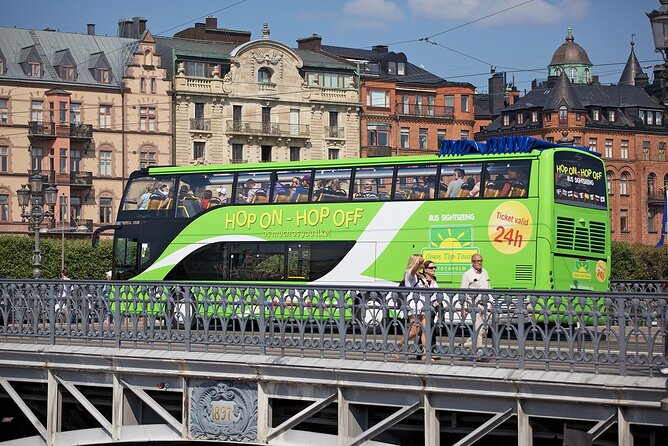
The pass includes hop-on hop-off bus options with Stromma and also mentions the existence of another provider with similar red branding. That can create confusion because both can look like the same kind of service at a glance.
From real-world pacing logic, the big limitation is that hop-on hop-off routes tend to wrap up in the late afternoon. I’d treat them as a daytime tool for getting between clustered museums and viewpoints, not as something to lean on for an evening plan.
Still, when it’s working for your schedule, the bus and included boat-tour-style route options are useful for two reasons:
- They help you get your bearings fast
- They can reduce the need for constant transit planning between far-flung stops
A Smart Way to Use This Pass in 2 Days
If you’re doing only 2 days, focus on your highest “payoff per hour.”
A strong pattern is:
- Day 1: Vasa Museum early, then Royal Palace/Royal Armoury in the same general palace area
- Day 2: Pick one large museum block (Nordiska Museet or Nationalmuseum or Fotografiska), then add one special experience like Globen Skyview or ICEBAR Stockholm
This keeps you from bouncing around too much and helps you avoid losing hours to transit.
If you want water, swap one indoor museum on day 2 for a canal tour or an archipelago boat—if your dates align with seasonal operation. The pass includes many such options, but winter timing and seasonal closures can affect availability.
Should You Book the Stockholm Pass?
Book it if you’re serious about stacking paid attractions. This pass is at its best when you do enough admissions that the per-person cost feels spread out across many included sights. I’d especially recommend it if you want a mix of major museums like Vasa Museum, royal-area history, and at least one boat or view-based experience.
Skip it or consider buying less time if:
- Your plan is mostly one museum and a few walks
- You’re traveling outside the seasonal window for boats and outdoor attractions
- You’re not willing to do a quick app check for QR access before each entry
One last practical note: the pass only works smoothly when your QR and your app are ready. If you’re the type who hates phone setup on vacation, build extra time on day 1 to confirm everything is scanning.
If you’re flexible and you plan your days around clusters, this pass can be a very efficient way to see Stockholm without constantly paying for separate tickets.
FAQ
What’s the main advantage of this Stockholm Pass?
The big advantage is the digital pass with QR codes on your cellphone, letting you enter select attractions without voucher redemption.
Does the pass include Vasa Museum admission?
Yes. Vasa Museum is listed as an included stop with admission ticket included.
How long is the pass valid once activated?
Your pass is activated upon your first attraction visit and stays valid for the number of consecutive calendar days purchased (not 24-hour periods). Passes remain valid for 1 year from date of purchase.
Are all attractions available year-round?
No. Several options are marked seasonal, including amusement and archipelago-related experiences. Check the app/digital guide for what’s running during your dates.
Do all included attractions require reservations?
Not all of them, but the information provided states that some activities require reservations, and you should use the Go City app to reserve where necessary.
Is ICEBAR Stockholm included for everyone?
ICEBAR Stockholm is included, but it’s adults only according to the description.